
BESTCARE BUILD · AUCKLAND OUTDOOR LIVING
Pergola With Louvred Roof: Auckland Guide
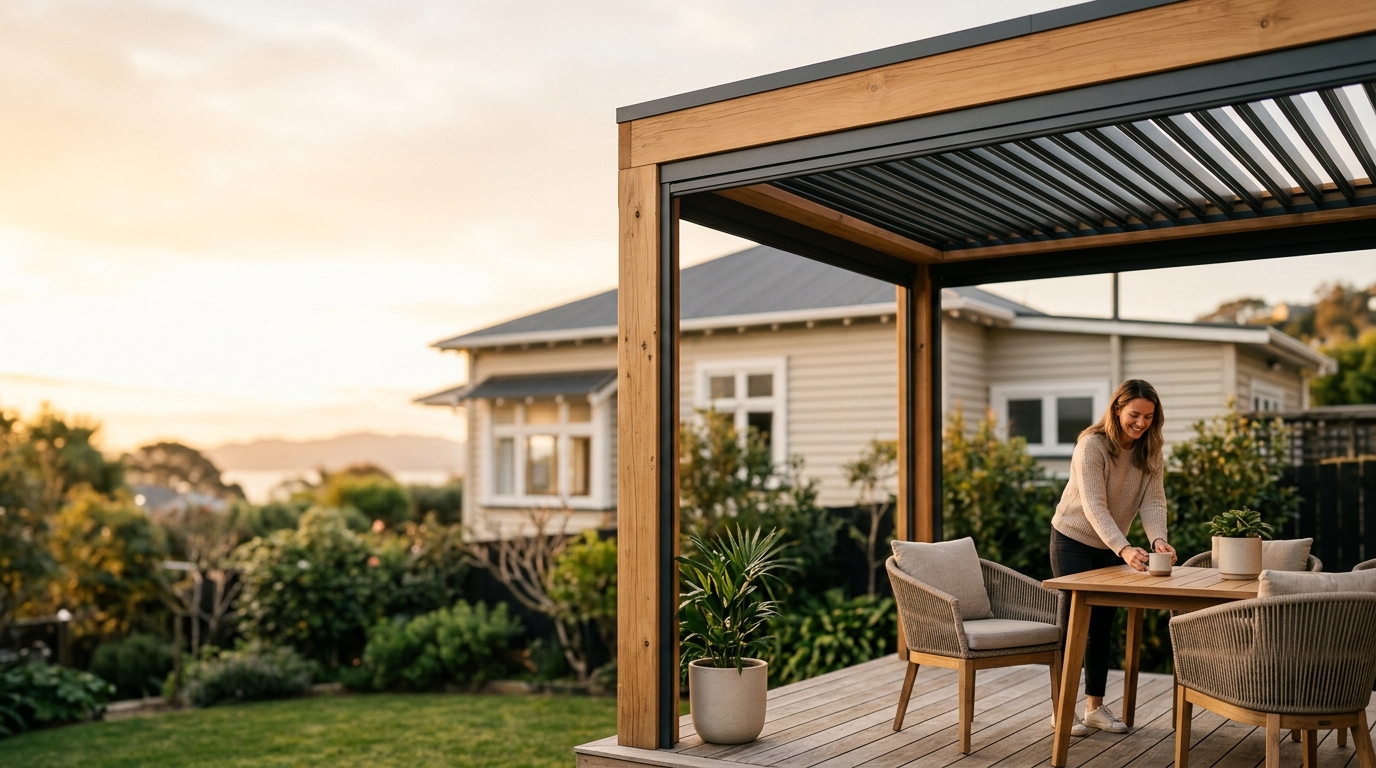
What is a louvred pergola and how does it work
A pergola with louvred roof features adjustable aluminium slats that rotate to control sunlight, shade and rain. Unlike a fixed-roof pergola or traditional open frame, the louvres pivot from fully open to fully closed—typically through a 0 to 110 degree range. When open, the slats sit nearly vertical and allow full sun and airflow. When closed, they overlap to form a weathertight seal that sheds rain into integrated gutters along the perimeter beams.
Each louvre blade connects to a drive shaft running the length of the pergola. Turning that shaft rotates all blades in unison. Manual systems use a hand crank mounted on a post. Motorised systems operate via wall switch, remote or app. Some motorised models include rain sensors that close the roof automatically when moisture is detected, and sun sensors that adjust the angle based on time of day.
The frame is powder-coated aluminium, engineered to carry the louvre weight and resist wind loads. Posts anchor to concrete slabs, timber decks or steel brackets. Cross-beams span between posts, and louvre blades sit within channels in those beams. Internal gutters collect water when the roof is closed and direct it down through posts or external downpipes. Louvered roof pergolas are built with concealed hardware and seamless joints—no visible fasteners that trap moisture or corrode.
Morning coffee in winter sun, lunch in summer shade, dinner under cover during a passing shower—all without moving furniture. That flexibility is why louvred systems have become the default choice for Auckland outdoor rooms.
Why louvred pergolas suit Auckland's climate
Auckland averages over 2,000 hours of sunshine yearly and more than 1,100 millimetres of rain. A fixed-roof pergola handles rain but loses sun benefit; a bare frame loses rain benefit. An adjustable louvre roof handles both.
Summer humidity makes airflow essential. A covered but unventilated space becomes a sauna in February. The tilt range on a louvre roof keeps cover overhead while opening gaps between blades, so breeze passes through and the space stays comfortable even on still, humid afternoons. North-facing and west-facing pergolas in Remuera, Herne Bay and St Heliers catch strong afternoon sun from November through March—closing louvres to 45 degrees provides shade without blocking ventilation.
Winter sun is worth catching. Low-angle midday sun in winter sits well below the summer position. A partially tilted louvre catches it through gaps to warm the space. On a clear June morning, open the louvres to 70 or 80 degrees and let sun stream in, then close them by mid-afternoon when temperature drops. That seasonal flexibility extends usable months without separate heating or full enclosure.
Rain arrives unpredictably throughout the year. A louvred roof in closed position sheds water as effectively as solid panel roof, and integrated gutters channel it away from deck or patio below. Wind is consistent in many Auckland suburbs—particularly on the isthmus, North Shore and coastal areas. Quality louvred systems are rated for wind speeds up to 220 kilometres per hour when properly installed, exceeding design loads required for residential structures under New Zealand building standards.
You adjust the roof to suit the day, rather than accepting a fixed compromise that works well only part of the year.
Cost, materials and manual vs motorised options
Louvred pergola prices in New Zealand range from around $15,000 for basic manually operated systems to $40,000 or more for large motorised installations with integrated lighting and sensors. A typical 4 metre by 4 metre motorised pergola with louvred roof installed by an experienced Auckland builder sits in the $25,000 to $35,000 range, including engineering, consent documentation and connection to existing deck or patio.
Aluminium is standard. It doesn't rot, warp or require annual maintenance beyond a hose-down. Powder-coated finishes resist UV damage and salt corrosion—important in coastal suburbs like Takapuna, Devonport and Mission Bay. Frame and louvres are extruded sections designed to interlock without exposed fasteners, so water doesn't pool in screw holes or along joins.
Manual systems use a hand crank on one post. Turn the crank to rotate louvres from open to closed—about 30 seconds for standard-sized roofs. Manual operation costs $3,000 to $5,000 less than motorised and has no electrical components to maintain. The trade-off is convenience. If it starts raining while you're inside, you walk out and crank the roof closed.
Motorised systems use low-voltage motors and wall switches, remotes or smartphone apps. Some include rain sensors that close the roof automatically when moisture is detected, and sun sensors that adjust louvre angle based on time of day. Motorised operation adds $4,000 to $6,000 to total cost. Motors require servicing every three to five years, and replacement parts are available from manufacturers. For most Auckland homeowners, convenience justifies the additional cost, particularly on larger pergolas where manual cranking becomes effort.
Wind resistance varies by model. Highest-rated systems handle wind speeds up to 220 kilometres per hour, suiting exposed sites on ridgelines or coastal properties. Standard residential systems are rated for 150 to 180 kilometres per hour, meeting Auckland Council's design wind loads for most suburban locations.
Powder-coated aluminium is available in neutrals—white, grey, black, charcoal—and some manufacturers offer custom colours to match your home's exterior. Matte finishes are most popular in Auckland for low-glare appearance and resistance to showing fingerprints or water marks.
Installation, consent and integration with your deck
Installing a pergola with louvred roof typically takes two to three days once site is prepared and materials are on hand. Posts bolt directly to embedded brackets on new concrete slabs. On existing timber or composite decks, posts either sit on deck surface with bolted base plates, or extend through deck to anchor into ground or substructure below. The second method is stronger and preferred for larger pergolas or exposed sites, but requires cutting through deck boards and sealing around posts.
Cross-beams bolt between posts, and louvre channels sit within those beams. Louvres slot into channels, connect to drive shaft and lock into position. Internal gutters integrate into beam sections, so water flows from closed louvres into gutters and down through posts or external downpipes. For motorised systems, electricians run low-voltage cable from motor to switch location—typically inside adjacent room or on external wall near pergola.
Auckland Council requires building consent for most pergolas. A louvred roof system with integrated gutters and sealed roof in closed position is generally treated as a building rather than simple garden structure, so consent applies regardless of size. Your builder confirms consent requirements for your specific site and prepares documentation, including engineering drawings, wind load calculations and details of how the pergola connects to existing deck or house.
If your deck is older or showing signs of movement, have it inspected before adding a pergola. A louvred roof system is permanent and performs best when anchored to stable base. For more on deck construction and standards, see our Auckland deck builders page.
Building new deck and pergola together simplifies design. Deck substructure and pergola posts can share the same foundation system, and the builder can plan deck board layout to accommodate post positions without awkward cuts. This approach also allows deck and pergola to be consented as single project, reducing overall timeline and cost.
Electrical work for motorised systems must be carried out by licensed electrician and included in consent documentation. Motors run on low-voltage power—typically 24 volts—so electrician installs transformer near pergola and runs cable to motor and switch.
Maintenance and long-term ownership in Auckland
A pergola with louvred roof requires minimal maintenance compared to timber structures. Aluminium frames and louvres need a hose-down two to four times yearly to remove dust, pollen and salt spray. In coastal suburbs like Mission Bay, Takapuna and Herne Bay, salt accumulation is faster, so quarterly cleaning is recommended. Use soft brush and mild detergent if needed, but avoid abrasive cleaners or high-pressure washers that can damage powder-coat finish.
The louvre mechanism needs lubrication once yearly. Light spray of silicone lubricant keeps blades rotating smoothly and prevents squeaking. Motorised systems require servicing every three to five years—checking gearbox, replacing worn components and confirming rain and sun sensors function correctly. Most Auckland installers offer service plans covering annual lubrication and periodic motor maintenance for fixed annual fee, typically $150 to $250.
Gutters and downpipes need checking twice yearly, particularly in autumn when leaves and debris accumulate. Blocked gutters cause water to overflow onto deck or patio below. Quick visual inspection and flush with hose is usually enough. If your pergola sits under or near trees, consider gutter guards.
Powder-coat finish is durable but can be scratched or chipped by furniture, tools or falling branches. Touch-up paint matched to your pergola's colour is available from manufacturer or installer—quick dab over exposed aluminium prevents rust spreading.
Annual maintenance sits in the $50 to $200 range if you do cleaning and lubrication yourself, or $200 to $400 with service plan. Motor replacement, if needed, costs around $1,500 to $2,500, but motors typically last 10 to 15 years with proper servicing. Compare that to timber pergolas requiring annual staining and sealing at $500 to $1,000 yearly, plus periodic replacement of rotted timber—aluminium is the lower-cost option over 20 years.
Frame and louvre warranties typically run 10 to 15 years, covering structural defects and finish degradation. Motor warranties are shorter—usually 3 to 5 years. Your installer's workmanship warranty covers installation itself and typically runs 12 months.
Auckland's climate isn't harsh on aluminium, but it tests installation quality. Poorly sealed joints, inadequate post anchoring or undersized gutters show up within the first year or two. A well-installed pergola with louvred roof from an experienced builder performs reliably for decades with only routine maintenance. The key is choosing a builder who understands Auckland's wind loads, drainage requirements and council consent process, and who uses quality materials from reputable manufacturers.
For homeowners planning new outdoor living areas, a louvred pergola offers flexibility to adapt to Auckland's variable weather, durability to last without constant upkeep, and comfort to extend usable outdoor space across all four seasons. For more on outdoor structures and planning, see our pergolas page.