
BESTCARE BUILD · AUCKLAND OUTDOOR LIVING
Deck Building Guide NZ: Materials & Costs
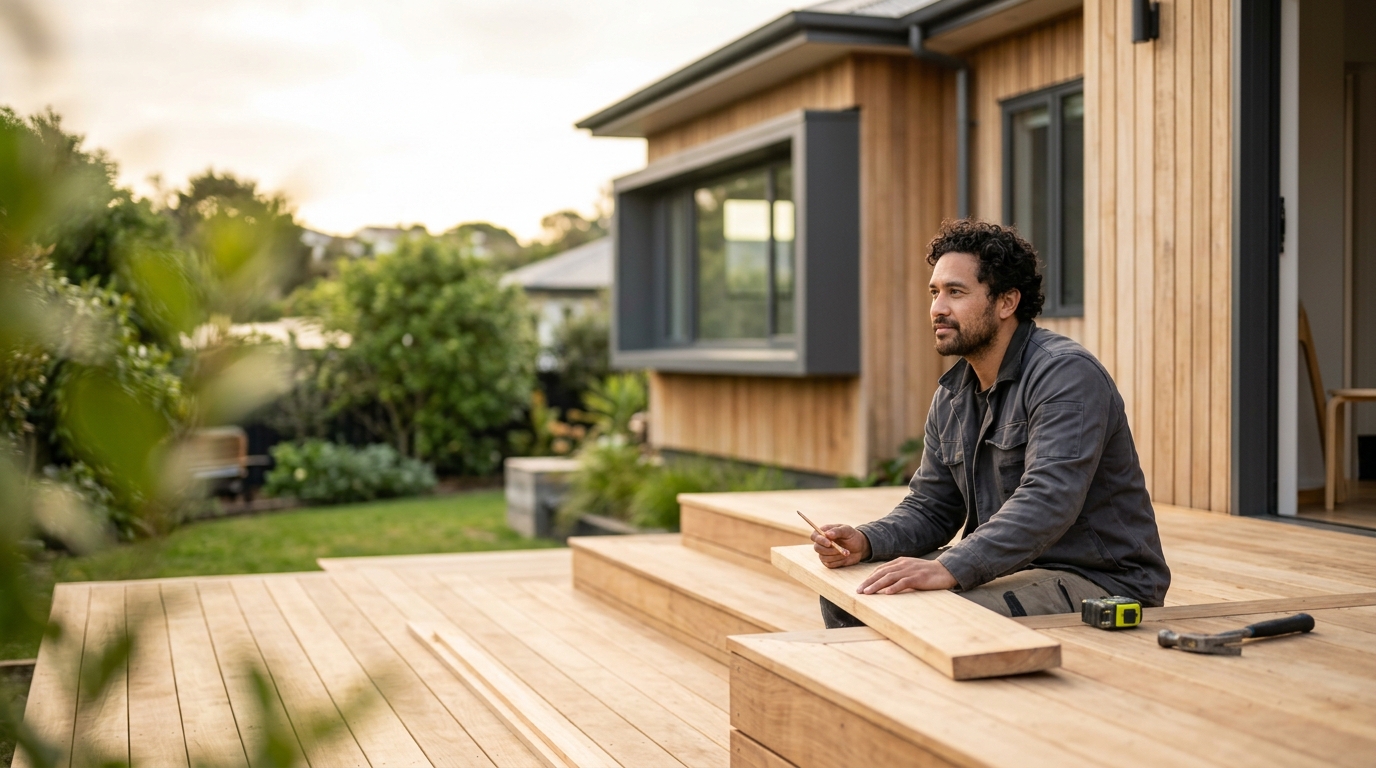
Timber vs Composite: Material Options for Auckland Homes
When planning a deck building guide nz project, your material choice shapes everything from upfront cost to weekend maintenance for decades ahead. Auckland homeowners typically weigh three main options: treated pine, Kwila hardwood and composite decking. Each suits different priorities, budgets and lifestyles.
Treated pine remains New Zealand's most common decking timber. It's locally grown Pinus radiata treated to H3.2 standard for outdoor use, making it the most affordable entry point at $350–$550 per square metre installed. Pine accepts stain and paint readily, so you can match any colour scheme. The trade-off is durability: softwood warps and bends under Auckland's harsh summer sun, and you'll commit to maintenance every six to twelve months to prevent greying and splitting. Pine suits budget-conscious builds, rental properties or situations where you plan to upgrade within 15 years.
Kwila decking sits at the premium end of timber options. This Southeast Asian tropical hardwood brings natural resistance to termites, fungi and decay. Kwila is rated as a Class 2 durable hardwood for 15 to 25 years in above-ground applications, though well-installed and properly maintained Kwila decks regularly reach 25 to 30 years. The timber's density makes it less prone to cracking than pine, and it handles New Zealand's variable weather without the warping issues softer timbers face. Kwila's rich reddish-brown colour eventually fades to a warm driftwood shade—a patina many homeowners prize. Expect to pay $550–$900 per square metre installed. One practical consideration: new Kwila "bleeds" tannins when wet, leaving reddish-brown stains on surfaces below until the timber weathers. Plan your landscaping accordingly or seal the underside. Kwila suits homeowners who value natural timber character, plan to stay long-term and don't mind oiling every 12–18 months.
Composite decking blends recycled plastic with wood fibres to create boards that resist rot, never splinter and need almost no maintenance beyond occasional washing. Modern composites cost $500–$800 per square metre installed—overlapping both pine and lower-end Kwila pricing—but the value proposition lies in eliminating annual staining and sealing. Most composite products carry 15 to 25 year warranties against structural defects and excessive fading. Composite suits families with young children (no splinters), time-poor professionals, holiday homes where maintenance windows are scarce, and anyone prioritising low-effort outdoor living.
Decking Costs: Pricing, Lifespan and Long-term Value
Understanding the full cost picture for your deck building guide nz project means looking beyond the initial invoice. Material lifespan and replacement timing dramatically affect what you actually spend per year of use.
Treated pine delivers the lowest entry cost but the shortest service life. At $350–$550 per square metre installed and a lifespan of 15-25 years, you're looking at roughly $18–$37 per square metre per year before maintenance costs. That calculation assumes you reach the upper end of the lifespan range—achievable with diligent care, but many pine decks show significant wear by year twelve, especially on north-facing exposures in Auckland's intense summer UV.
Kwila's higher upfront investment spreads across a longer timeline. At $550–$900 per square metre installed and a realistic lifespan of 25-40+ years for hardwoods, the annual cost drops to $14–$36 per square metre—competitive with pine despite the premium price tag. The density and natural durability of Kwila mean boards stay structurally sound well into their third decade when properly maintained. Homeowners in established Auckland suburbs like Remuera, Epsom and Herne Bay often choose Kwila for this longevity, particularly when the deck forms a key architectural feature they expect to enjoy for decades.
Composite decking typically costs $500–$800 per square metre installed—mid-range pricing that looks expensive against pine but reasonable against Kwila. The material carries 15 to 25 year warranties, and over a 25+ year lifespan, you could see lifetime savings of up to 40% with composite when you factor in eliminated annual costs of staining, sealing and replacing warped or rotting boards. At $20–$32 per square metre per year (before maintenance savings), composite becomes the most cost-effective option for homeowners planning to stay put long-term.
The core insight: the cheapest material upfront rarely delivers the best value over time. Match your material choice to your actual timeline in the home and your realistic commitment to ongoing care.
Maintenance Reality: Time and Money Over 25 Years
Maintenance separates deck building guide nz theory from lived experience. The hours you spend and the dollars you commit over decades often matter more than the initial build cost.
Treated pine demands the most attention. Traditional wood decks require annual cleaning, staining and sealing, costing between $300 to $600 per year for professional service or 8–12 hours of your weekend if you DIY. Over 25 years, that's $7,500–$15,000 in professional maintenance or 200–300 hours of your time. Pine needs this attention every six to twelve months to prevent the greying, splitting and surface degradation that Auckland's weather accelerates. Miss a year and you'll see the consequences: boards cup, splinters emerge and the protective coating fails, letting moisture penetrate and rot begin.
Kwila reduces that burden but doesn't eliminate it. A clean and an oil every 12–18 months is the commitment with Kwila—roughly half the frequency of pine. The oiling process takes 4–6 hours for a typical deck and costs $200–$400 if you hire it out. Over 25 years, expect $3,300–$6,700 in professional maintenance or 100–150 hours DIY. The reward is a deck that holds its structural integrity and develops a rich patina rather than looking neglected.
Composite decking flips the equation entirely. Composite requires less maintenance than wood—periodic cleaning but no staining or sealing—with annual maintenance costs typically $100 to $200. That's a garden-hose wash and soft brush twice a year, maybe 2–3 hours total annually. Over 25 years: $2,500–$5,000 and 50–75 hours. No weekend lost to sanding and staining, no scrambling to finish before rain arrives, no chemical smell lingering for days.
The maintenance gap explains why busy families, professionals and holiday-home owners increasingly choose composite despite higher upfront costs. If your time is worth $50 per hour, the 150–250 hours you save over 25 years versus timber represents $7,500–$12,500 in opportunity cost—enough to cover most of the material price difference.
Choosing the Right Deck for Your Auckland Home
Your ideal deck building guide nz material depends on four practical factors: your budget structure, your timeline in the home, your maintenance appetite and your site conditions.
Budget structure means how you weight upfront cost versus ongoing spending. If you're stretching to afford the deck now, pine makes sense. If you can absorb a higher initial investment, Kwila or composite deliver better lifetime value. Run the numbers for your specific situation: multiply the installed cost per square metre by your deck size, then add 25 years of maintenance at the rates above. The total often surprises homeowners who assumed pine was "cheaper."
Timeline matters because short-term owners and long-term residents face different economics. Planning to sell within ten years? Pine's lower upfront cost makes sense, and you'll exit before major maintenance bills arrive. Staying twenty years or more? Kwila or composite pay back their premium through longevity and reduced upkeep. For investment properties or renovations before sale, consider what buyers in your suburb expect—established Auckland areas like Parnell, Ponsonby and Takapuna often see Kwila as a quality signal that supports asking price.
Maintenance appetite is personal and honest self-assessment matters here. If you enjoy hands-on property care and take pride in a freshly oiled deck, timber rewards that effort with natural beauty. If weekends are scarce or you'd rather spend them using the deck than maintaining it, composite removes the guilt and the chore. Don't choose timber hoping you'll "find time" for maintenance—that's how decks deteriorate prematurely.
Site conditions include sun exposure, shelter, drainage and proximity to trees. North-facing decks in full Auckland sun punish pine and accelerate Kwila's colour fade, making composite's UV stability attractive. Shaded decks under trees accumulate moisture and organic debris, favouring Kwila's rot resistance or composite's imperviousness over pine's vulnerability. Coastal properties face salt spray that composite handles better than timber. Sloped sites with drainage issues need materials that won't rot when occasionally wet—another point for composite or Kwila over pine.
For most Auckland homeowners building a deck they'll use for fifteen years or more, Kwila offers the best balance of natural beauty, proven durability and manageable maintenance. Composite suits time-poor households, families with young children and anyone prioritising convenience. Pine works for budget-constrained builds, short-term ownership or situations where you plan to upgrade the whole outdoor space within a decade.
Building Your Deck: What to Plan Before You Start
A successful deck building guide nz project starts months before the first board goes down. Front-load your planning to avoid expensive changes mid-build and ensure the finished deck suits how you'll actually use it.
Design for use, not just aesthetics. Walk through your daily and seasonal routines: morning coffee, evening entertaining, kids playing, BBQ setup, furniture placement, sun and shade patterns across the day. Sketch where people will move and gather. This exercise often reveals that the deck should be larger, shaped differently or positioned to capture afternoon sun rather than morning glare. Consider access from indoor living areas—a deck that requires walking through the laundry to reach won't get used. Think about privacy from neighbours and views you want to frame or screen.
Understand your site's constraints. Check your property's slope, drainage patterns and soil stability. Steep sites need more substantial substructure, adding cost. Poor drainage means water pools under the deck, accelerating timber rot—you may need to improve drainage before building. Measure existing features: trees you want to keep, garden beds, clotheslines, outdoor taps. Confirm boundary setbacks with your property title; decks too close to boundaries may need neighbour approval or council consent.
Budget realistically for the full project. Your deck cost includes more than decking material. Account for substructure (bearers, joists, posts, concrete footings), fixings and fasteners, balustrades if the deck is elevated, stairs, lighting, and any site preparation like excavation or retaining. A typical deck's substructure and labour can equal or exceed the decking material cost. Build in a 10–15% contingency for unexpected ground conditions or design changes.
Choose your builder carefully. Look for builders with specific decking experience in Auckland conditions, not just general carpentry skills. Ask to see completed projects in suburbs similar to yours and speak with past clients about how the deck has performed over time. Verify they understand local building codes, can handle council consent if needed and offer clear warranties on both materials and workmanship. Experienced Auckland deck builders will ask detailed questions about your lifestyle, budget and maintenance willingness before recommending materials—that consultation is where good projects begin.
Consider the full outdoor living picture. A deck rarely works in isolation. Think about how it connects to fencing, garden beds, paths and other outdoor structures. Many homeowners build the deck first, then wish they'd coordinated it with a pergola for shade or integrated planters for greenery. Discuss these elements during design even if you'll add them later—it's easier to plan mounting points and structural support during the build than retrofit them afterwards.
The most successful deck projects start with clear priorities, realistic budgets and honest conversations about how you'll use and maintain the space. Take time to plan thoroughly, choose materials that match your actual lifestyle and work with builders who understand Auckland conditions. The result will be an outdoor living space that enhances your home for decades.